> But they don't change human genes, at most they change gene expression.
It's not clear in this case what the difference is between gene, gene expression, and gene encoding. What does gene mean if it does not imply either encoding or expression? If this is a disagreement about the semantics of encoding, surely it'd be easiest to express this in terms of encoding. If this is about gene expression, surely it'd be easiest to express this in terms of expression. "gene" largely has no meaning outside of encoding/expression.
It seems clear to me the article is indicating a distinction of encoding. I'm not sure where the ambiguity is.
First, a point of clarification: coding and encoding are two different things. "Encoding" is a CS term that doesn't come up much in biology. (You could say that DNA is an encoding of a base-4 number sequence.) "Coding" is a bioinformatics term — DNA base-pairs code for particular RNA sequences; and then, only if they're in a coding region. (Analogy: flux patterns on a floppy disk code for particular bytes, but only if they're in a sector.)
Second: what are genes? A "gene" is an abstraction.
Let's first define a "genome". A genome is the complete dump of raw data of "what the DNA base-pair sequence string says" — before any coding or expression occurs. Whenever we sequence DNA, it's [parts of] this raw base-pair string that we get back — not the codons, not the expressed RNA sequences. And this is why we care — sequencing is the tool we have, so it's the lens by which we look at DNA. And that lens shows us the raw data.
When we talk about "genes" (or "SNPs" / other bioinformatics terms), we're basically talking about the ways in which that raw data we can extract through sequencing, relates to observed phenotypic changes. A "gene" is a particular part of a "genome" (DNA base-pair sequence) that can be uniquely identified as being the cause of interesting phenotypic consequences when changes are made to it. (Which in turn is how we figure out what genes are "responsible for" doing what.)
Note how these concepts, "genome" and "gene", both completely ignore epigenetics / gene expression. That's because these terms were invented before epigenetics was invented, and these terms are part of a model that uses a lens (DNA sequencing) that itself ignores epigenetics. Gene sequencing shows you the world of DNA as if epigenetics didn't exist.
Now let's talk about DNA.
If you think that epigenetics is about changing how DNA encodes information, then you might be thinking of "DNA" via the lie-to-children model, of it just being a long sequence of nucleotides.
But consider: why do chromosomes look the way they do — little X shapes? A long string of base pairs, on its own, has no reason to assemble into that macroscopic shape.
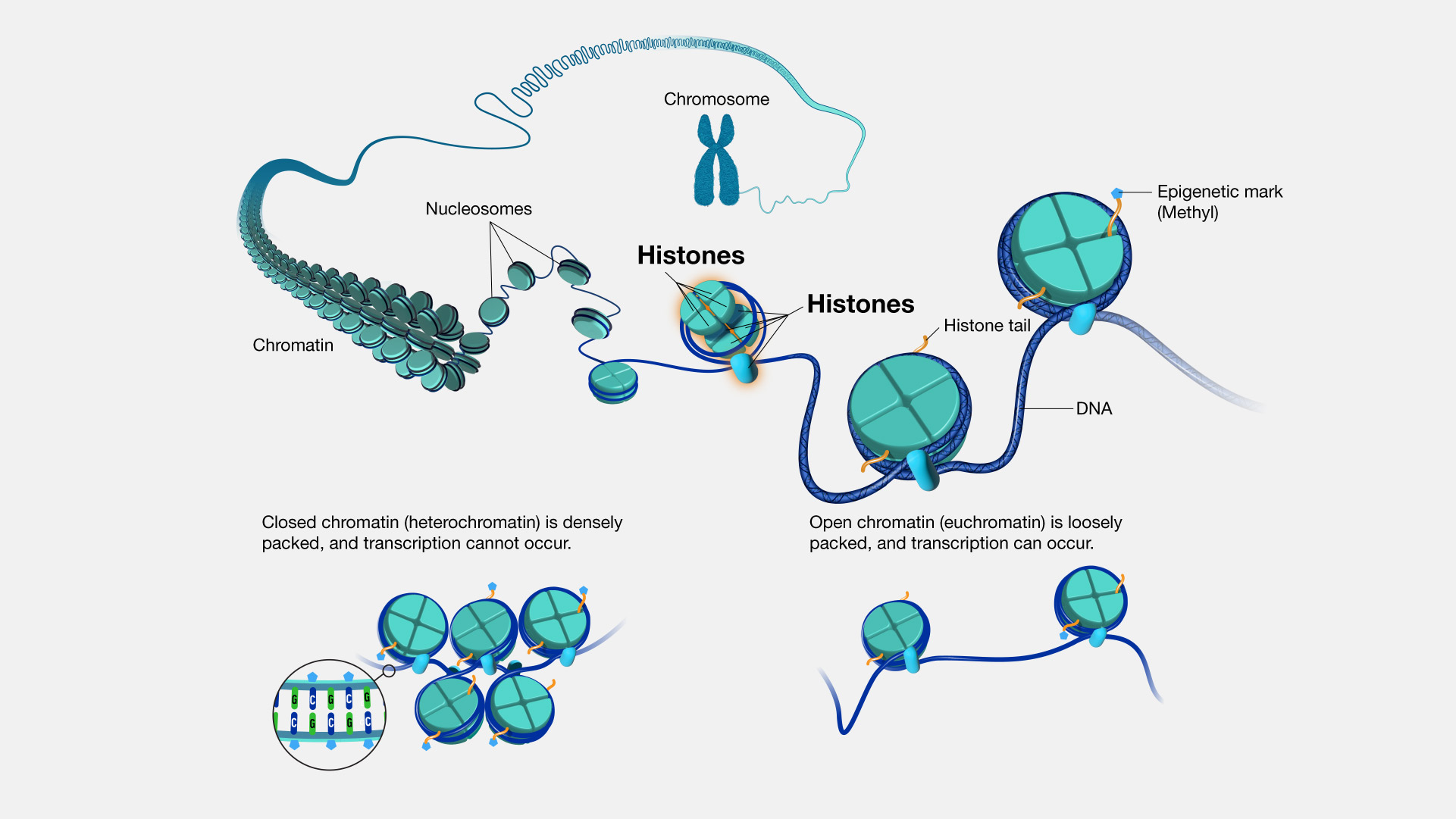
This is because "DNA" — which is really a shorthand for "the DNA complex" (i.e. a complex of multiple weakly-bound molecules that together form the chromatin of a chromosome) — is not just nucleotide base-pairs. The nucleotide base-pairs form one molecule (the deoxyribonucleic acid string itself); but then you've got other stuff. You've got histones — little tape-spools the DNA string is wrapped onto. You've got methyl groups — little markers hanging off particular places on the DNA string. You've got other stuff I don't personally understand/know about.
When lay-people talk about "DNA", they're really referring to the whole complex of molecules that makes up each one of your chromosomes.
"Genes" are just the bioinformatic data representation of the deoxyribonucleic-acid-base-pair-string part of that complex of molecules.
But gene coding, and gene expression, are both a result of what the other molecules in that complex are doing.
(Think about it: if gene coding + expression were encoded in-band by the DNA itself, then that information would be appear in DNA sequencing — and so we'd be unable to differentiate that information from changes to the DNA itself — and so we wouldn't even have a concept of "epigenetics", because it would all just look like "genetics"!)
Histones — those little tape spools — attract or repel each-other due to chemical modifications to the histones themselves. Two histones that "snap together", prevent the region of DNA "tape" between them from being physically accessed by the RNA polymerase enzymes that "read the tape" to produce RNA.
Methylation markers hang off of the initial "landing sites" for RNA polymerase enzymes (CpG dinucleotides — think "floppy-disk sector header"), and repel them.
When you sequence DNA, you ignore these transcription-silencing signals. You can picture DNA sequencing as "unrolling" the deoxyribonucleic acid off of its histone carriers, rendering them irrelevant; and then using molecular tools to read the sequence — tools that, unlike RNA polymerase, are not repelled by methyl-groups.
If you use more-modern techniques to capture this additional information about where these silenced regions are, and by what mechanism they've been silenced, then you get what we call an "epigenome" — which isn't a post-translated version of DNA, but rather sort of a "metadata track" that runs parallel to the DNA "data track."
(And you can, in theory, combine the two to calculate an "expressed genome." I don't think we've ever done that yet — partly because "whole-epigenome sequencing" doesn't yet exist in the way that "whole-genome sequencing" does; and partly because epigenetic metadata is probabilistic — with some modifications decreasing the probability of a region coding for something, rather than turning it off altogether — and so current approaches, that derive the epigenome "by reaction", would observe something like "weak bits" on a floppy disk — regions that read differently each time, requiring many passes to calculate a "flux strength" for each region and to find each silenced region's true borders.)
I appreciate the effort you've put in above, but I think you're defining both gene and genome from too narrowly. Both terms predate our understanding of the structural mechanisms of heredity.
A gene is a unit of heredity.
The genome is the sum total of all genetic information in an organism.
Both are extremely loose terms. Individual sub-fields of biology/biochemistry may use more specific variations in specific contexts, but the definitions above cover all of those meanings.
The terms were essentially redefined more strictly as our understanding of genetics grew more refined.
(I.e. per my sibling post, there were jargon terms with these names that had one particular definition under an early, black-box mental model of heritability that is no longer used/favored; and there are new replacement jargon terms with the same names, that have a different definition under the more-modern mental model of germline heritability.)
After all, there are entirely non-genetic mechanisms of heredity. You inherit some of your mother's immune histochemistry through developmental exposure, and more through consuming breastmilk. Yet there is nothing that "codes" for this histochemistry; it's just a stateful process (mother's immune system) interacting with another stateful process (foetal immune system) — working almost more like a "colonization" of commensal bacteria than like gene transfer.
In terms of "heritable traits" — "nature vs nurture" — such effects appear squarely on the "nature" side. But they're not germline heritable. Implant the fertilized egg into a surrogate mother, and you get different histochemistry. Have a wetnurse feed the baby, and you get different histochemistry.
If these things are "genetics" — if the information carried by the state of immune cells in response to observing natal antigens is "genes" — then the term "genetics" has no useful meaning / is useless to talk about the thing we want to talk about when we talk about genetics. Where "what we talk about when we talk about genetics", is how an organism's breeding/germline ancestry, predicts phenotypic outcomes.
And if you agree that that is the thing we want to talk about — then epigenetic information isn't "genes" (under the germline-heritability model) either. Your epigenetics is hereditary, but only in the same sense that your immunohistochemistry is hereditary — being passed via exposure in a natal environment, rather than being "written into" the fertilized egg.
(Also — at least AFAIK — we don't even consider our nuclear mitochondrial DNA to be a part of our genomes. Even though it is passed through the germline, and is intensely important in many congenital metabolic dysfunctions. Because our mitochondria are not technically "us" — we might call them organelles, but they're still more like commensal prokaryotes in how cells treat them: dividing on a separate timeline from our cells; not assortatively assigned to daughter cells by spindle fibers during mitosis; not observed + checkpointed to ensure sufficient numbers exist for daughter cells before telophase; etc.)
This is the sort of long-form comment that I'd write and love to read, signed in just to upvote it, well-put!
Nit: chromosomes mostly don't look like little X-shapes except during cell division, which was historically a useful time to image them (I think because the dye couldn't get through the cell-nucleus wall but during cell division it has dissolved?). But then you are seeing _two_ chromosomes that happen to be bound at a centromere before that centromere gets torn into two by the cytoskeleton dividing the cell in half.
> A "gene" is a particular part of a "genome" (DNA base-pair sequence)
See, this is a non-starter. Sure it's coherent, but you've simply failed on step one to identify how humans communicate. Regardless of if you're referring to "coding" or "encoding" (I'm not sure of the semantic difference between these two terms, frankly, nor an understanding why this distinction is worth presenting without remediation) a gene is still a heritable trait, not a specific span of a specific encoding of a specific molecule. A gene is, colloquially, a heritable trait that implies no specifics about how it's coded/encoded into whatever substrate you choose. You're referring to a far more specific term most people won't recognize as meaningful, and you can either explicitly describe what you're discussing or accept that people will misunderstand you.
I see you're trying to advocate for specific terminology to agree on, but it's far more effective to meet people where they already are rather than trying to push jargon onto others.
If I'm wrong, that people specifically refer to subsets of a DNA encoding by referring to "gene", please educate me.
You are not wrong but even among biologists and geneticists there are differences of opinion and differences of context. If a mouse geneticist says they knocked out gene X they usually mean that they inactivated the production of mRNA from a specific gene “model”. If you were talking to Richard Dawkins he would have a much more expansive definition of a “gene” that would include a much longer sequence of DNA (many protein-coding genes) that remains in a particular state long enough to be selected for (or not) or to drift to fixation or extinction.
It is not quite right to say:
“a gene is … a heritable trait.” This definition equates gene with trait. Yes that is how Mendel thought about his results since he could only see and quantify traits. But there are still a depressingly large number of protein-coding genes without linkage to traits.
We are not generally mouse geneticists, though. We are assumably a proxy for the general public.
> It is not quite right to say: “a gene is … a heritable trait.”
This is a reality of communication you need to deal with: that's absolutely how people will interpret the term "gene".
> Yes that is how Mendel thought about his results since he could only see and quantify traits. But there are still a depressingly large number of protein-coding genes without linkage to traits.
From my perspective, from my exceedingly humble opinion, "heritable trait linked by reproduction and not culture" is absolutely how the public at large understands the term "gene". The fact that scientists cannot successfully link protein-coding to linguistically-bound traits is an issue that scientists will have to work around when communicating about the specifics of heritability, genetic determinism, and discretization of individuals. "Gene" is simply not a term you can reliably link to DNA in the popular consciousness and is likely not worth the effort or money to redefine.
> See, this is a non-starter. Sure it's coherent, but you've simply failed on step one to identify how humans communicate.
No. There are two distinct ways in which humans communicate.
• Humans create and use words, whose usage stretches and spreads and grows and can only be defined descriptively.
• Humans (doing professional/technical/scientific work) also define-into-existence jargon terms — the meaning of which is set in stone at the moment of creation.
Jargon terms are verbal handles we use to grasp parts of particular, well-defined mental models — models that are taught and learned as coherent systems of such terms; models that exist to enable their users to think rigorously, and collaborate without corruption of meaning/loss of rigor, to "get things done" in those professional/technical/academic contexts.
Jargon terms, therefore, can always be said — definitively, objectively(!) — to have been employed correctly or incorrectly in any given text, per the mental model in which the jargon term is defined.
Sometimes, professionals/technical people/scientists are dumb and silly, and attempt to invent a jargon term made of words, where those words, put together in that order, have such an obvious, novel, and useful lay usage, that it is inevitable that anyone who hears the term will already think they know what it means, before ever being formally taught what it means.
"Begs the question" is an example of this — there is something so uniquely useful about the lay meaning of that phrase (essentially "a situation that demands that an unstated question be asked"), that whoever named (or more likely, translated from Latin into English) that logical fallacy, made a mistake by choosing to use those words to name it.
But that situation is rare.
Most of the time, professionals/technical people/scientists make up a word all on their own, to be jargon, entirely for their own use. (Often they use Latin for this, as an intentional way to dodge the aforementioned problem of the word "seeming like it has an intuitive meaning" in any living language. But they don't have to. They can also just make up a nonsense word, perhaps one inspired by a Latin prefix or something — a word like "gene.")
And then, through a pipeline of scientific discoveries, to science journalism, to pop-science, to regular people just talking about how their aunt has asthma due to "that bad gene she got from her father" — somewhere along the line, someone screws up in how they're using the jargon term; and that screwed-up understanding proliferates.
But jargon terms — at least the ones that are part of mental models anyone still employs any more — must still be used to do work. And they cannot function to do that work, if people can't use them with the implicit understanding that they are communicating an exact, precise, well-defined idea. Such words are not merely words; they are professional tools. The professionals that use these tools, cannot allow them to be corrupted, to have their meanings diffuse.
And so, at least the professionals themselves, will always be taught that any jargon term they learn has one specific meaning — that it acts as a handle for a particular concept in a particular mental model.
And those professionals will insist on this strictness when working with any technical writer or editor.
And this strictness diffuses from there, into any editorial context where editors consider themselves to be professionals, working for a publication that expects professionalism — whether that publication is technical or non-technical.
In professional editing, is always expected that if any term (word or phrase) is used which is known to be a (unique, non-colliding) jargon term rooted in some technical/academic mental model, then that term should only be permitted if it is being used with its original jargon meaning. Any other handling of such a term is considered a usage error, effectively a typo.
(For non-unique/colliding jargon terms where lay usage exceeds jargon usage, the lay-usage is given represented by plain printing, while the jargon usage is represented by italic printing. This only ever comes up with phrases — "begging the question" again — because even the most ivory-tower academics know that overloading the meanings of single extant lay words is a stupid way to invent jargon.)
This is a long spiel to justify refusing trying to communicate in an effective manner. I understand the concept of professionals recognizing the quality standards others put forward, but at some point you've got to care if you even come of as sensical to non-professionals if you want to communicate to them. This necessarily implies a reaction to something not being "but they misused the word gene!!!".
It doesn't matter when lay people misuse professional jargon. It matters when professionals speaking to lay people misuse professional jargon. (As was what was being pointed out as wrong about the OP article — it is professional writing, from the PR department of a university!)
In other words, it's about "those who know" being a role model for correct usage by "those who don't know."
(Why bother? Because then people are more likely to come into the profession with an understanding of the concept that's at least compatible with teaching them the model; rather than having an understanding of the model so debased that they need to actively unlearn it before they can learn the correct model.)
> What does gene mean if it does not imply either encoding or expression?
The less mutable part. The strongly heritable stuff. Genes are part of your body, as is your brain, that doesn’t mean your every thought is equivalent to DNA.
Having said that, there's some very recent research to suggest that memories / neuronal weights are actually encoded directly in neuronal DNA.
(this does not mean that this DNA is directly heritable, since it does not necessarily end up in the gametes, but it is still interesting that, yes, in fact, it involves DNA change)


It's not clear in this case what the difference is between gene, gene expression, and gene encoding. What does gene mean if it does not imply either encoding or expression? If this is a disagreement about the semantics of encoding, surely it'd be easiest to express this in terms of encoding. If this is about gene expression, surely it'd be easiest to express this in terms of expression. "gene" largely has no meaning outside of encoding/expression.
It seems clear to me the article is indicating a distinction of encoding. I'm not sure where the ambiguity is.