Agreed, read the article. Economics is a bit like physics in (and only in) that much of it isn't something you can solve through intuition alone, and quite often you'll get the wrong answer.
My question for you is does your intuition think this trend will continue, or is it temporary?
Your naive hypothesis is true. The ratio of cash to non-cash has been decreasing over time, as more digital payments are used. As everyone also knows, cash is a nominal value, it doesn't inflate. Anyone trying to intuit cash demand would be thinking about inflation rates and nominal gdp growth.
I think digital payments would explain a lot of why the correlation sharply reverses in 2020.
The problem is if you want to go further and say; since digital payments will increase during the pandemic, all demand for cash will decrease. I disagree that's an intuitive idea.
Covid changed the money supply and peoples behavior rapidly, saying you can't use intuition under higher uncertainty is a tautology - no field is immune to this. Also going past intuition, the decline in cash as a percentage of total money accelerated, due to the M2 increase being much larger.
Just because covid shocked a few things doesn't mean that economics insn't intuitive or that peoples intuition is wrong. It's like trying to reason about terrorist attack danger using data just after 9/11.


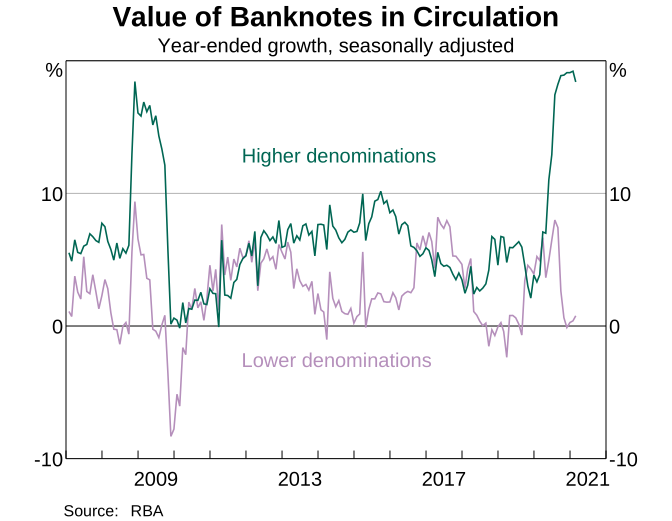
An example, nobody uses cash for payments anymore, demand for bank notes must be down. And yet: https://www.rba.gov.au/publications/bulletin/2021/mar/pdf/ca...