I got a pair of this for Christmas and just recently put them in my ears for the first time having no idea they had noise cancellation built in. For a second I thought I broke my ears because everything was dead silent! I'm surprised how well the noise cancellation works, way better than the ancient Sony headphones I had.
Is there an objective way to measure this so someone would know it's getting worse? Seems like it would be really subjective if not.
You can measure the dB of noise reduction on a headphone test bench.
Under the Isolation section here they have leakage (sound spilling out to others) and isolation (noise canceling). Keep in mind that dB is nonlinear, and the test results depend a lot on how well the testers fit the headphones on the head - so I would only consider these to be approximations within 1-3 dB of the real value.
Rtings hasn't (yet) done a pre/post update comparison for the AirPods but you could use the same methodology.
The HyperX Cloud II are a good (isolation/leakage-wise) set of 'normal' over-ear headphones which you can compare the numbers to if you've never used ANC and are curious. And the Sony WH-1000XM3 / Bose 700 are the leading noises canceling over-ear headphones.
The Sony XM3s are an awesome piece of hardware. The noise cancellation is top notch, the ear cups are the most comfortable and large enough to not put too much pressure (specially for folks like me who wear specs) and are extremely lightweight with ample cushioning.
Best 25k INR (was around 30% of my monthly salary == monthly rent) I ever spent.
Yeah, really impressed with them myself. The noise cancellation is really impressive compared to my Bose QC20 (which I was very impressed with at the time, and I still hold on to as a really portable pair), music sounds amazing on them, and I can wear them all day without discomfort.
There are a couple of small things I’d change, primarily making it easier to connect/toggle between multiple Bluetooth devices (right now I either have to disconnect on the first device then connect on the second, or turn the headphones off and then on in pairing mode). Also it would be nice to have a clearer visual indication of whether they are on or not and what the battery level is - the battery life is great, but it’s quite easy to not realise they are low and/or leave them on by accident.
I’d highly recommend them anyway. Great for an office environment. Personally I did find a slight discomfort to the noise cancelling at first but very quickly adjusted, so this seems to be a very personal thing.
I like mine but I wish they were more breathable. Of course that's hard with a closed design which probably is necessary for noise cancellation, but as someone who gets hot easily I have to take them off for a while every 30 minutes or so. No way I can use them in summer out in the open and even on the train I get sweaty fast.
But apart from that they're very comfortable and the NC is awesome.
I use Sony XM3s every day on the way to and from work, and a lot of the time I am there too. They're great.
The only thing that would make me happier is if they made a model with more passive sound isolation / insulation. The noise cancelling is awesome, but it can only do so much. I would gladly pay for this in increased size and weight. The amount of outside noise I want to hear is zero.
I bought it on Amazon in a daily deal for ₹15K but I had to return it as the box and headphone were damaged. They didn’t replace, just refunded citing the end of the deal.
>Is there an objective way to measure this so someone would know it's getting worse?
In principle it should be possible to do standardized testing of any set of headphones or earphones with a properly designed Dummy Head, similar or the same to what is used for things like generating binaural audio recordings. There at least were a number of major Dummy Head designers back when I last looked for something else, though I don't know what the current state of the market is. But basically you have something that physically simulates a human head, including both physically simulated ear pinnae and the ear canals, with microphones embedded within them that have a high enough res and response to completely cover the human discernible audio frequency range.
Obviously it won't tell the exact effect for any given individual because the shape of our ears varies. But it would be possible to have a completely open 3D/material/mic standard that would cover the max range, and could then be used to quantify and objectively compare all aspects of head mounted audio products, not just noise cancellation but audio reproduction. I assume this isn't a thing already in part because a lot of manufacturers are perfectly content without universal objective comparisons, since that would reveal a lot of high cost kit that isn't actually delivering any gains.
Some 4 years ago I did a bunch of work in this field and just wanted to chime in about a tool that I haven't seen anywhere else that was great - HEAD acoustics' Artemis Suite analysis software.
Audio has a huge array of analyses that can be performed, and the output can be interpreted in a huge number of ways, but Artemis had a fascinating data-flow architecture that made generating and interpreting audio, graphical and numerical data relatively easy (once you climbed the steep learning curve). It decoupled project management, input data, analyses, and output destinations in a way that made engineering easy.
I haven't worked with any software like it before or since, but would do another project in a heartbeat! Tragically, it's locked behind a proprietary $$,$$$ license, front-end, and calibrated recording hardware. But here's a screenshot to give you an idea: https://i.imgur.com/XXzlP2b.png. If you get serious about buying a head and fronted, call them up and get a demo.
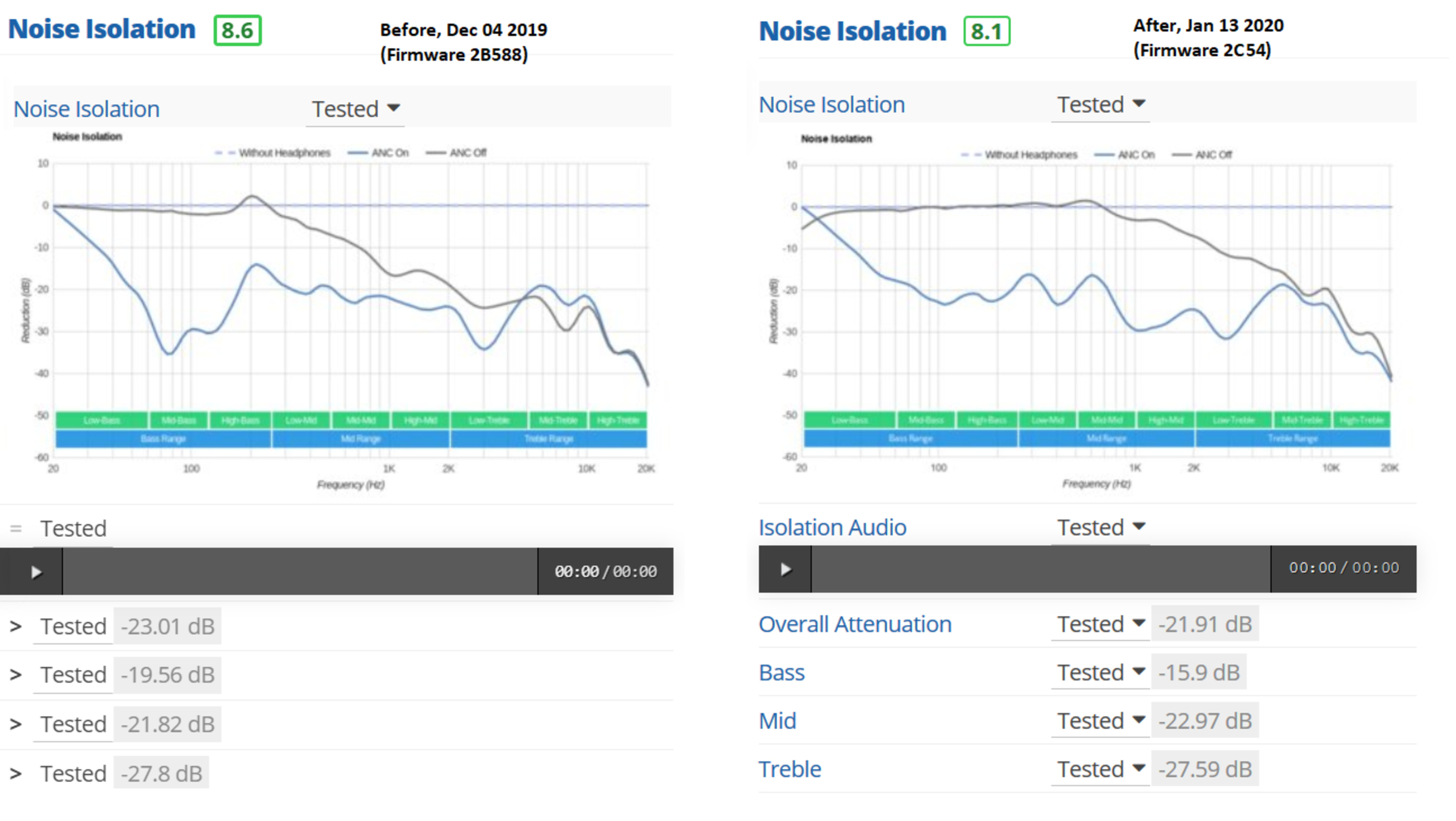
Can someone help me interpret these two graphs? The updated one seems to be a lot smoother across the frequency range if a bit less effective on average. Maybe smoother noise cancelling is better in some perceptual way?
Yeah. I bought them day one with the old firmware and was a bit disappointed that the anc was weaker with high noises as I was used by my sonys. Didn't pay attention to any change when the firmware hit. And if hadn't read about it today, I couldn't have told you that they changed it. But maybe indeed they improved on the first impression I had.
> The updated one seems to be a lot smoother across the frequency range if a bit less effective on average. Maybe smoother noise cancelling is better in some perceptual way?
The first time I put them on, I was in a room with a fan, and I thought it'd lost power because I didn't hear it. Took me a second to realize, nope, it was the noise cancellation.
With products like this, you really do want an actual anatomical ear for measurement - often they rely a lot on the rough physics of the ear itself to work right. There is a whole niche corner of the microphone industry for "dummy head microphones" that are basically an an actual model of a head with detailed ears, and are really useful for measuring both how things sound to a human in an open environment and getting measurements of devices like headphones that need a head + ear to work.
Thanks for the comment. I don't know the answer but came here to ask this too. It seems really useful to be able to objectively measure the efficacy of noise cancellation across diverse products.


Is there an objective way to measure this so someone would know it's getting worse? Seems like it would be really subjective if not.